If you have money sitting in a current account earning little or no interest, it could be worth checking what savings rates are available.
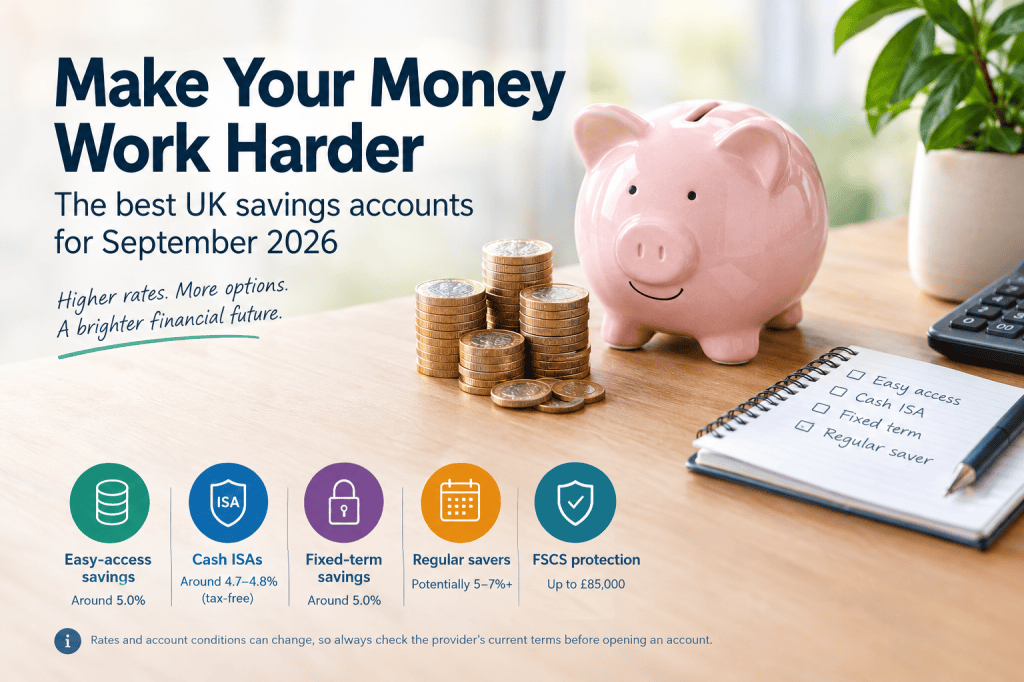
Savings rates can change frequently, but as of September 2026, some UK savings accounts are offering rates around 5%, while some mainstream banks continue to offer considerably less.
What rates are available?
Here are some examples of competitive rates currently available:
| Type of accountExample rateWhat to consider | ||
|---|---|---|
| Easy-access savings | Around 5.0% | You can generally withdraw your money when needed |
| Easy-access Cash ISA | Around 4.7–4.8% | Interest is tax-free |
| Fixed-term savings | Around 5.0% | Your money is usually locked away for a set period |
| Fixed-term Cash ISA | Around 4.8% | Tax-free interest, but your money may be locked away |
| Regular saver | Potentially 5–7%+ | Often requires regular monthly deposits and has limits |
svg
Rates and account conditions can change, so it’s important to check the provider’s current terms before opening an account.
Easy access vs fixed savings
The right account depends largely on when you might need your money.
Easy-access savings can be useful for an emergency fund or money you may need at short notice. You normally have the flexibility to withdraw your savings, although some accounts may have restrictions.
Fixed-term savings accounts can offer competitive rates if you know you won’t need the money for a particular period. The trade-off is that you may not be able to access your money, or may face restrictions or penalties for withdrawing early.
Don’t forget about Cash ISAs
A Cash ISA is another option worth considering, particularly if you pay tax on your savings interest.
Interest earned in a Cash ISA is generally tax-free, and the current annual ISA allowance is £20,000.
Whether a Cash ISA is the right choice depends on your circumstances and the rates available compared with ordinary savings accounts.
Check more than just the interest rate
A high headline rate doesn’t necessarily mean an account is right for you.
Before opening an account, check:
- Whether the rate is fixed or variable.
- How often interest is paid.
- Whether there are withdrawal restrictions.
- Whether there is a minimum or maximum deposit.
- Whether the advertised rate is a temporary bonus.
- Whether the provider is covered by the Financial Services Compensation Scheme (FSCS).
The FSCS deposit protection limit is an important consideration when deciding where to keep larger amounts of savings.
Shop around
One of the easiest ways to potentially improve your savings returns is simply to compare accounts regularly.
Rates can change, and an account that was competitive a year ago may no longer be near the top of the market.
For current rates and account conditions, comparison services such as MoneySavingExpert, Moneyfacts and Which? can be useful starting points. You should also check the provider’s own website before applying.
Final thought
You don’t necessarily need to move all your money to one account. You could keep an emergency fund in an easy-access account while considering fixed-term savings or a Cash ISA for money you don’t expect to need immediately.
Even a small difference in interest can add up over time, particularly on larger balances.
Always check the current rate, terms and FSCS protection before opening a savings account.




Leave a comment